
Pages


we offer a wide range of audit and assurance services designed to provide our clients with accurate, reliable, and insightful financial information. Our team of experienced professionals ensures compliance with all regulatory requirements while enhancing the overall financial health of your organization. Here’s a detailed look at our key audit and assurance services:

The statutory audit is mandated by the Companies Act to ensure the accuracy and fairness of a company's financial statements.
An Income Tax Audit is required to verify the accuracy of income tax returns and to ensure that all income and deductions are properly reported.
The GST Audit ensures that the company’s GST returns are accurate and comply with the GST laws and regulations. Identifies discrepancies and areas for correction in GST filings and helps in avoiding penalties and interest due to non-compliance.
Transfer Pricing Certification ensures that all related party transactions are conducted at arm’s length and comply with regulatory requirements.
Internal audits are conducted to evaluate and improve the effectiveness of governance, risk management, and control processes. It helps in assessment of operational efficiency and effectiveness. Identification of potential areas for improvement and providing recommendations.
Due diligence services provide a detailed assessment of a company’s financial health, operational performance, and compliance status, usually in the context of mergers and acquisitions, investments, or strategic partnerships.
Beyond compliance, our audits provide valuable insights into your business operations, helping you improve efficiency, manage risks, and achieve your strategic goals.
For more information on how JNCY & Associates can assist you with your audit and assurance needs, please contact us today. Our team is ready to provide you with the highest level of professional service.
Taxation services encompass a wide range of professional services aimed at helping individuals and businesses comply with tax laws and optimize their tax liabilities. These services can be broadly categorized into two types: Direct Tax Services and Indirect Tax Services.
Direct taxes are taxes that are levied directly on the income or wealth of individuals or organizations. These taxes are paid directly to the government by the taxpayer. Key components of direct tax services include:

Individual Income Tax: Assistance with filing personal income tax returns, tax planning to minimize liabilities, and ensuring compliance with current tax laws.
Corporate Income Tax: Services for businesses, including tax return preparation, strategic tax planning, and advisory to optimize corporate tax positions.
Assessments & Appeals: Representing clients during income tax assessment and appeals, preparing necessary documentation, and resolving disputes with tax authorities.
Cross-Border Taxation: Advisory services for businesses and individuals with income from multiple countries, ensuring compliance with international tax treaties and local laws.
Double Taxation Avoidance Agreements (DTAA): Helping clients navigate and benefit from DTAA to avoid being taxed twice on the same income in different jurisdictions.
Expatriate Taxation: Tax planning and compliance services for expatriates, including understanding host and home country tax obligations.


Documentation and Compliance:Assisting multinational corporations in documenting and justifying their transfer pricing policies to tax authorities.
Policy Development: Creating and implementing transfer pricing policies that comply with international guidelines and local regulations.
Dispute Resolution: Representing clients in disputes with tax authorities regarding transfer pricing issues.
Income from Indian Sources: Advising NRIs on the tax implications of their income from Indian sources such as property, investments, and business operations.
Foreign Income and Assets: Helping NRIs manage their global income and assets in a tax-efficient manner.
Repatriation of Funds: Assisting in the legal and tax-efficient repatriation of funds from India to the NRI's country of residence.

Indirect taxes are taxes that are levied on goods and services rather than on income or profits. These taxes are typically included in the price of goods and services and collected by an intermediary (such as a retailer) from the person who ultimately bears the tax burden (such as the consumer). Key components of indirect tax services include:

GST Registration and Compliance: Helping businesses register for GST, file GST returns, and comply with the complex GST regulations.
Input Tax Credit: Advising on the eligibility and claiming of input tax credits to minimize the GST payable.
GST Audits and Assessments: Representing businesses during GST audits and assessments, and resolving disputes with tax authorities.
GST Refunds: Assisting businesses in claiming GST refunds for goods and services purchased.
Customs Duty Compliance: Assisting businesses in complying with customs regulations, including the classification of goods, valuation, and calculation of duty.
Excise Duty:Helping businesses understand and comply with excise duty requirements on the manufacture of certain goods.

Taxation services play a crucial role in helping individuals and businesses navigate the complex and ever-changing landscape of tax laws. Whether dealing with direct taxes like income tax and transfer pricing or indirect taxes like GST and customs duties, professional tax we provide valuable support to ensure compliance, optimize tax liabilities, and manage risks effectively. By leveraging these services, our clients can focus on their core activities with the confidence that their tax matters are in capable hands.
Financial advisory services play a crucial role in guiding businesses through complex financial landscapes, helping them make informed decisions, optimize financial performance, and achieve their strategic objectives. These services encompass a broad range of offerings, here's an in-depth look at financial advisory services:
Chief Financial Officer (CFO) services provide strategic financial management and leadership to businesses that may not have the resources to hire a full-time CFO. These services include:

Financial Strategy Development: Crafting long-term financial strategies that align with business goals.
Financial Reporting and Analysis:Preparing accurate and timely financial statements, performing financial analysis, and advising on financial performance.
Budgeting and Forecasting: Developing budgets, financial forecasts, and financial models to support decision-making.
Cash Flow Management: Managing cash flows to ensure liquidity, optimizing working capital, and planning for future cash needs.
Risk Management: Identifying financial risks and implementing strategies to mitigate them.
Investment Advisory: Guiding investment decisions, managing portfolios, and assessing investment opportunities.
Loan syndication involves arranging a large loan for a borrower by involving multiple lenders, each providing a portion of the total loan amount. Key aspects of loan syndication include:
Structuring the Loan: Designing the loan package to meet the borrower’s needs and ensuring terms are acceptable to all lenders.
Negotiation and Documentation:Facilitating negotiations between the borrower and lenders, preparing necessary documentation.
Distribution and Allocation: Allocating the loan among participating lenders based on their capacity and preferences.
Monitoring and Compliance:Ensuring compliance with loan covenants and monitoring the borrower’s financial performance.

Credit Monitoring Arrangement (CMA) data is essential for businesses seeking working capital loans from banks. Services in this area include:

Data Collection and Analysis: Gathering financial data and performing detailed analysis to understand the working capital needs.
Financial Projections:Preparing financial projections, including projected balance sheets, income statements, and cash flow statements.
Ratio Analysis: Conducting ratio analysis to demonstrate financial health and creditworthiness.
Presentation: Compiling the data in a structured format as required by financial institutions for loan approval.
Assessing project viability and preparing financial forecasts are crucial for evaluating new projects or expansion plans. This includes:
Feasibility Studies:Conducting detailed feasibility studies to assess the technical, financial, and market feasibility of a project.
Cost-Benefit Analysis:Evaluating the costs and benefits associated with the project to determine its viability.
Financial Projections: Preparing detailed financial projections, including revenue forecasts, expense estimates, and profitability analysis.
Risk Assessment: Identifying potential risks and developing mitigation strategies.

Cash flow projections and project reports provide critical insights into a business’s financial health and the potential success of projects. Services include:
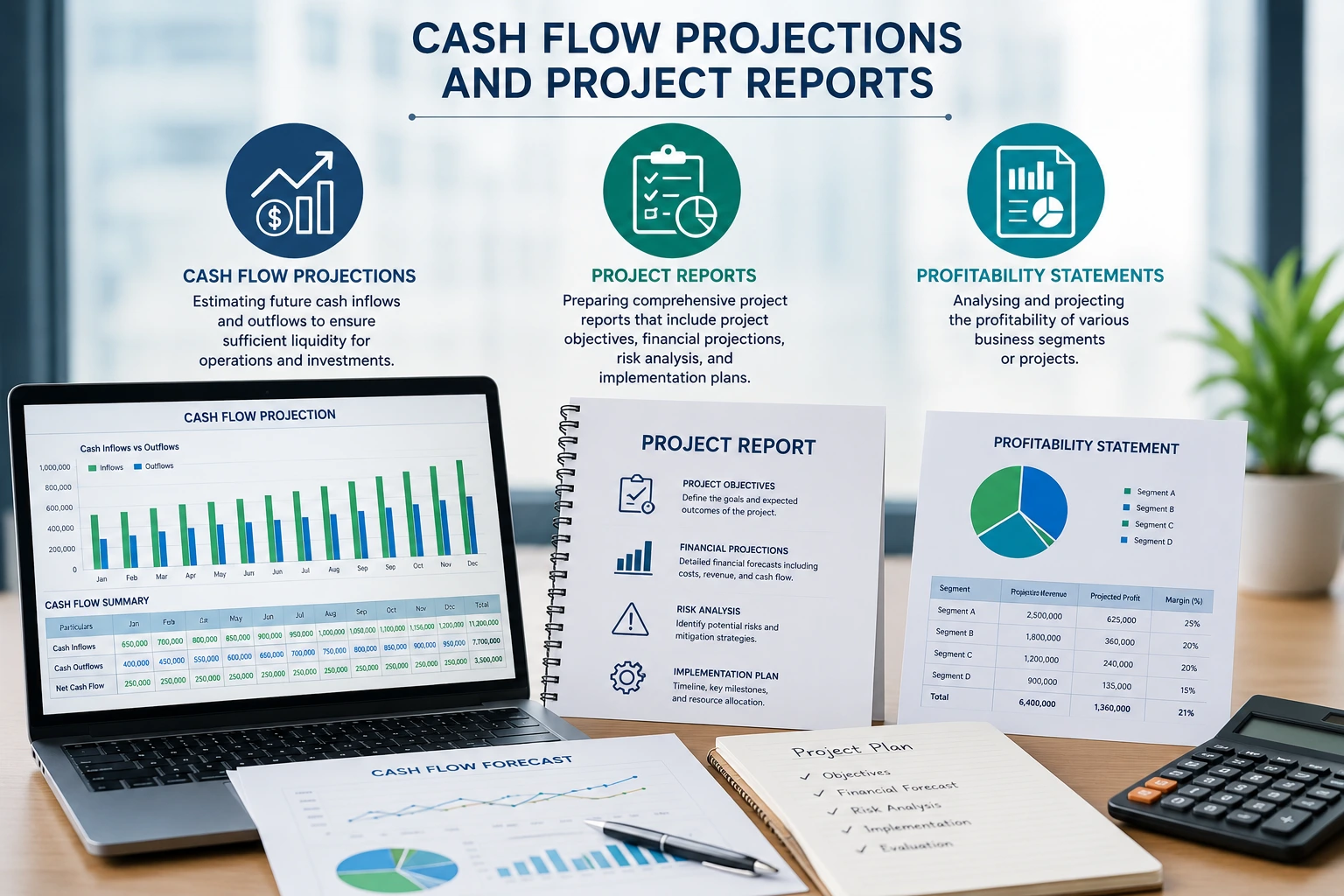
Cash Flow Projections: Estimating future cash inflows and outflows to ensure sufficient liquidity for operations and investments.
Project Reports:Preparing comprehensive project reports that include project objectives, financial projections, risk analysis, and implementation plans.
Profitability Statements: Analysing and projecting the profitability of various business segments or projects.
Feasibility studies and assessments for expansion schemes help businesses evaluate new opportunities and plan for growth. This involves:
Market Analysis:Conducting market research to understand demand, competition, and market potential.
Technical Feasibility:Assessing the technical requirements and challenges of new projects or expansions.
Financial Feasibility: Evaluating the financial implications, including investment requirements, operating costs, and expected returns.
Regulatory Compliance: Ensuring that all regulatory requirements are met for new projects or expansions.

Financial advisory services assist businesses in securing various types of loans to meet their funding needs. This includes:

Business Loans:Helping businesses secure loans for operational needs, expansion, or capital investments.
Mortgage Loans: Assisting in obtaining loans secured by real estate properties.
Term Loans: Facilitating long-term loans for major capital expenditures or investments.
Businesses can benefit from various government subsidies and grants. Financial advisory services help in:
Identifying Eligible Subsidies/Grants:Researching and identifying government programs that offer subsidies or grants relevant to the business.
Application Preparation:Preparing and submitting applications for subsidies and grants, ensuring all requirements are met.
Compliance and Reporting: Ensuring compliance with the terms and conditions of the subsidies or grants and preparing necessary reports for government authorities.

Financial advisory services are integral to the financial management and strategic planning of businesses. By leveraging these services, businesses can enhance their financial performance, ensure compliance with regulations, secure necessary funding, and make informed decisions about growth and expansion. Professional financial advisors bring expertise and experience that can significantly benefit businesses in navigating complex financial challenges and achieving their long-term objectives.
Accounting and bookkeeping services are fundamental to the financial health and regulatory compliance of any business, regardless of size. These services ensure accurate and systematic recording, analysing, and reporting of financial transactions. Below is a detailed overview of these services:
Accounting services involve the systematic process of recording, measuring, and communicating financial information. They help businesses understand their financial position, make informed decisions, and comply with regulatory requirements. Key components of accounting services include:

Balance Sheet: Summarizes a company’s assets, liabilities, and shareholders' equity at a specific point in time, providing insights into the financial health of the business.
Income Statement:Reports the company’s revenues, expenses, and profits over a specific period, showing operational performance.
Cash Flow Statement:Shows the inflows and outflows of cash, highlighting how the company generates and uses cash.
Budgeting and Forecasting: Developing budgets and financial forecasts to guide business planning and strategy.
Performance Analysis: Analysing financial data to assess business performance and identify areas for improvement.
Cost Accounting: Tracking, recording, and analysing costs associated with the production of goods or services to control expenses and enhance profitability.
Forensic Accounting: Investigating financial discrepancies and fraud, providing litigation support, and conducting financial crime investigations.
International Accounting: Handling accounting issues related to international operations, including compliance with different countries' accounting standards and regulations.
Bookkeeping services involve the accurate recording of financial transactions on a daily basis. This forms the foundation of the accounting process. Key components of bookkeeping services include:
Sales and Revenue:Recording all sales transactions, whether on credit or cash basis.
Purchases and Expenses: Documenting all purchases and expenses incurred by the business.
Payments and Receipts: Tracking all payments made to suppliers and receipts from customers.
General Ledger:Maintaining the general ledger where all financial transactions are summarized and categorized.
Subsidiary Ledgers: Maintaining detailed records of individual accounts such as accounts receivable, accounts payable, and inventory.
Bank Reconciliation:Matching the business’s financial records with bank statements to ensure accuracy and identify discrepancies.
Account Reconciliation: Ensuring that the balances in the accounting records match the corresponding figures in other records, such as supplier statements.
Employee Compensation:Calculating and processing employee wages, salaries, bonuses, and deductions.
Payroll Taxes: Ensuring accurate calculation and timely payment of payroll taxes to relevant authorities.
Benefits Administration: Managing employee benefits such as health insurance, retirement plans, and other perks.
Accounts Payable:Managing outgoing payments to vendors and suppliers, ensuring timely payments to avoid penalties and maintain good relationships.
Accounts Receivable: Tracking incoming payments from customers, ensuring timely collections to maintain cash flow.
Periodic Reports: Generating regular financial reports such as trial balances, aged receivables/payables reports, and expense reports.
Customized Reports: Creating tailored reports to meet specific business needs and support management decision-making.

Accounting and bookkeeping services are essential for the smooth operation and financial integrity of any business. By maintaining accurate records and providing detailed financial analysis, these services enable businesses to make informed decisions, ensure regulatory compliance, and achieve financial stability and growth. Whether outsourced or managed in-house, investing in professional accounting and bookkeeping services can provide significant benefits, including improved efficiency, reduced risk, and enhanced strategic planning.
Startup services encompass a wide range of support and expertise aimed at helping new businesses navigate the challenges of launching and growing successfully. These services provide startups with the necessary tools, guidance, and resources to build a solid foundation, scale operations, and achieve sustainable growth. Here’s a detailed look at the various startup services we provide:

Business Registration: Advising on the appropriate legal structure (e.g., sole proprietorship, partnership, LLP, Company). Assisting with business registration, incorporation, and obtaining necessary licenses and certificates.
Trademark and Patent Filing: Helping secure trademarks, patents, and copyrights to protect intellectual property.
Legal Compliance: Ensuring compliance with local, state, and central government regulations.
Contracts and Agreements: Drafting and reviewing contracts, partnership agreements, and other legal documents.
Accounting and Bookkeeping: Setting up accounting systems and processes tailored to the startup’s needs. Providing ongoing bookkeeping services to ensure accurate financial records.
Budgeting: Developing and managing budgets to track expenses and revenues.
Cash Flow Management: Monitoring and managing cash flow to ensure liquidity and financial stability.
Financial Reporting:Preparing regular financial reports to provide insights into the startup’s financial health.
Pitch Deck Preparation: Creating compelling pitch decks to present to investors.
Investor Relations: Managing relationships with investors and preparing for investor meetings.
Funding Strategy:Advising on funding options, including venture capital, angel investors, crowdfunding, and loans.


Process Optimization: Streamlining business processes to improve efficiency and reduce costs.
Supply Chain Management: Managing and optimizing the supply chain to ensure timely delivery of products and services.
Growth Planning: Developing strategies for scaling operations and expanding into new markets.
Resource Allocation: Efficiently allocating resources to support growth initiatives.
One-on-One Coaching: Providing personalized coaching to help founders overcome challenges and achieve their goals.
Mentorship Programs: Connecting startups with experienced mentors who can provide guidance and support.

Startup services are essential for the successful launch and growth of new businesses. By leveraging these services, startups can gain the expertise, resources, and support they need to navigate challenges, seize opportunities, and achieve sustainable success. We provide comprehensive startup services for building a thriving business.
© Copyright by JNCY & ASSOCIATES CA

